Objects are not as close–part 3

We also have the potential to increase our energy supplies (and replace existing sources) with solar, wind, thermal and water power.  New batteries and better solar cells both contribute to the utility of these energy sources.  But as for the rest of these items our readiness for the next surge is less certain.  In particular, and as always, there are factors that work against a successful deployment–these are the reactionary and vested interests that are being creatively destroyed or disrupted, not to mention backlash in the cultural arena.  These are not insignificant:

  • We have long had a streak of anti-intellectualism in the U.S. that surfaces persistently in religion (e.g., creationism), climate change (“no scientific proof”), and political ideology (bashing technocratic elites). These typically led by vested interests who hold these views (religious fundamentalists), or who cynically play to them in order to maintain power (today’s populists, primarily within the Republican Party).
  • Our education system performs well below the average of other developed countries, and we have a strong movement to privatize and theologize, that is to further splinter, public education, once one of America’s great strengths. Vested interests may favor technical education (to staff their organizations), but they don’t like liberal arts colleges that foster critical or creative thinking, which unfortunately are necessary to drive innovation.
  • Another wave of anti-immigration sentiment threatens to choke off a major source of innovation. Immigrants founded 52 percent of new Silicon Valley companies between 1995 and 2005, and a 2016 report showed that 44 out of 87, (51%) of the country’s $1 billion startup companies had at least one immigrant founder.
  • The federal government appears about to go on another quixotic quest to cut taxes, restore manufacturing jobs, and de-regulate everything despite 30 years of evidence that none of those policies work. It’s no accident that fossil fuel and speculative banking interests dominate the current U.S. federal administration.  Oil and gas drove the last (4th ) surge and financial capital drove the installation period of the 5th  They want to stay in control.
  • The mass market that powered the great post-war surge stopped growing 40 years ago. (See wage chart below (22).)  Unfortunately, broad-based surges need a large market, and the stagnation of incomes was a natural part of the installation phase of the current surge.  The issue is where the market for the deployment phase of the next surge will come from if U.S. incomes remain stagnant.
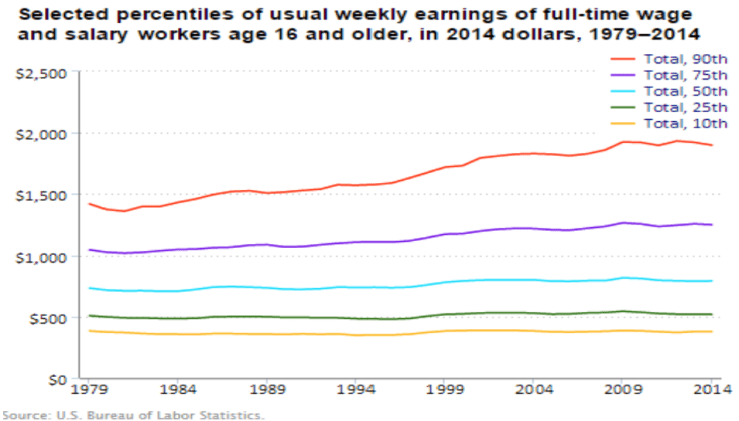
Wages 1979-2014 cropped

Remember, nothing is pre-determined: leading nations benefit from surges that begin in their economies, but they don’t necessarily lead the next surge.  In the 15th century the Chinese built an immense navy and established trade routes throughout the South China Sea and the Indian Ocean, but after the emperor died, the new ruler chose to focus on building the Great Wall (sound familiar?) and by 1500 the navy was no more. (23)  The Portuguese, the Dutch, and eventually the British assumed leadership in South Asia instead.  Similarly, the British led the first two surges based on water power and coal, but they did not lead thereafter, because they chose to pursue larger and quicker profits in the empire instead of investing in the home economy. (23)  Thus, Germany and the U.S. invested in and took leadership in steel, petrochemicals, and the electrical industry.

As Perez points out: “all technology provides is a substantial—and specific—potential for wealth creation in a range of possible directions.” (24)  The last wave—the automobile, oil, petrochemicals and mass production—supported three different economic regimes: Nazi autarky (economic self-sufficiency), Soviet communism, and Keynesian capitalism.  Selection of a specific course for each economic surge is not solely a market task.  It also depends on political leadership.  As Perez says, “The capacity of politicians and policy makers to understand what is really at stake will determine the success or failure in controlling finance, favoring the flourishing of production and employment, and benefitting the great majorities of the population.” (24, p. 214)

For policy makers the key insight is that this direction is neither pre-determined nor automatically defined by the technologies….Historically it has resulted from a combination of factors: the constellation of lifestyle-shaping goods and services made possible by the technologies; the ability of investors, entrepreneurs and governments to recognize the potential of these products; the political ideologies of those with the power to affect their deployment; and the socio-historical context in which they emerge. (25)

Global green surge next?

Perez has identified a potential huge opportunity for shaping and leading the next big surge.  Specifically, she advocates a “green” direction that converts the environmental crisis from an economic problem into an economic opportunity. (25, p. 15) “’Green growth’ also supposes the return—and heightened importance–of product durability, accompanied by maintenance as a key service.” (25, p. 18)

This could then lead to a very active rental sector for organizing second, third and Nth hand markets in each country and across the world, along with the growth of disassembly, remanufacturing, recycling, reusing and other materials-saving processes.  Information for 3-D printing replacement parts and the provision of regular upgrades for the maintenance of products could become standard practice….In the advanced world, such a business strategy would create great quantities of jobs for displaced assembly workers in maintenance, upgrading, warehousing, parts ‘printing’, distribution and installation; while design, redesign and many other creative industries and service would employ young university graduates.  A ‘green mission’ would thus be equivalent to the combination of post-war reconstruction, the Cold War and suburbanization in terms of demand creation, employment and directionality for innovation. (25, p. 19)

This strategy would reverse the current growth of income inequality, which is typical of the deployment stage of a surge, and it would extend a new, sustainable version of the “American way of life” to the rest of the world.  However, both government and classical economics must recognize that “the battle is not between state and markets; it is between policies that will maintain uncertain growth and increasing income inequality and a direction that can bring a sustainable global golden age that can lift all boats.” (25, p. 23)

Perez’s green path is probably too optimistic, but it could lead to faster automation of existing work, but–as is typical with technological revolutions—the nature of work will change to create new jobs and huge new global mass markets will multiply those jobs.  New jobs in new organizations will be the easiest to automate since the job design and human-machine interface can be built from scratch.  Automation of existing work and re-design of existing jobs will still be slow in most cases, but maybe we’ll eventually be able to automate the design and construction of user interfaces, too.

So, have we answered our question?  How quickly will we automate most existing work?

We demonstrated that job automation cannot be analyzed in isolation.  If Perez is correct, there is a potentially positive path to a new economic surge that would speed up job automation, and much else.  However, the current American leadership’s calamitous reactionary junket appears bent on squandering that opportunity.  Indeed, without a significant change in course, chaos and an economic depression seem a more likely outcome in the U.S. than a green global golden age.  Even if, by some miracle, we are able to dodge most of the devastating impact of environmental change, America is on course to surrender its position as the leading economy to a hungrier and more rationally led nation.  China, for example, might be able to pick up the baton and lead the next surge, just as the U.S. took the lead from the U.K. while the British focused on quick profits in the empire during the last half of the 19th century.

References

  1. http://www.mckinsey.com/business-functions/digital-mckinsey/our-insights/where-machines-could-replace-humans-and-where-they-cant-yet
  2. https://www.nytimes.com/2017/01/12/technology/robots-will-take-jobs-but-not-as-fast-as-some-fear-new-report-says.html?_r=0
  3. World Development Report 2016, World Bank, p. 23.
  4. http://www.oxfordmartin.ox.ac.uk/downloads/academic/The_Future_of_Employment.pdf
  5. http://www.economist.com/news/special-report/21700758-will-smarter-machines-cause-mass-unemployment-automation-and-anxiety
  6. http://www.marketwatch.com/story/trump-labor-secretary-pick-andy-puzder-talked-about-replacing-workers-with-robots-2016-12-08
  7. https://hbr.org/2013/04/change-management-needs-to-cha
  8. http://blogs.gartner.com/thomas_bittman/2015/02/05/why-are-95-of-private-clouds-failing/
  9. http://www.cio.com/article/2402706/enterprise-resource-planning/employees-refusing-to-use-clunky-enterprise-software.html
  10. https://www.bls.gov/lpc/special_requests/nonfarm_business.zip
  11. https://www.theguardian.com/society/2013/sep/18/nhs-records-system-10bn; http://spectrum.ieee.org/riskfactor/aerospace/military/the-us-air-force-explains-its-billion-ecss-bonfire; http://astro.temple.edu/~wurban/Case%20Studies/HP’s%20ERP%20Failure.pdf
  12. https://www.bea.gov//national/nipaweb/GetCSV.asp?GetWhat=SS_Data/SectionAll_xls.zip&Section=11 (1969-2016)
  13. https://www.bea.gov//national/nipaweb/GetCSV.asp?GetWhat=SS_Data/SectionAll_xls_Hist.zip&Section=11 (pre-1969)
  14. https://en.wikipedia.org/wiki/Creative_destruction
  15. As Time Goes By, Chris Freeman and Francisco Louçã, 2001, pp. 369-70.
  16. From the Bureau of Economic Analysis reported in “US Manufacturing: Understanding Its Past and Its Potential Future,” Martin Neil Baily and Barry P. Bosworth, Journal of Economic Perspectives, Winter 2014, pp. 3-26.
  17. http://majentaplm.com/events/industry-4-0-is-your-business-ready-for-the-next-industrial-revolution/
  18. “Energy, K-waves, Lead Economies, and Their Interpretation/Implications,” William R. Thompson in Kondratieff Waves: Dimensions and Prospects at the Dawn of the 21st Century, ed. Leonid E. Grinin, Tessaleno C Devezas, and Andrey V. Korotayev, 2012.
  19. “Technological Revolutions and the Role of Government in Unleashing Golden Ages,” Carlota Perez in Kondratieff Waves, 2012, pp. 211-218.
  20. “Deep Transitions: Emergence, Acceleration, Stabilization and Directionality,” Johan Schot and Laur Kanger, Science Policy Research Unit Working Paper Series, University of Sussex, September 2016.
  21. “Top 10 Emerging Technologies of 2016,” World Economic Forum’s Meta-Council on Emerging Technologies, June 2016.
  22. “A Look At Pay At The Top, The Bottom, And In Between,” U.S. Bureau of Labor Statistics, May 2015, p. 2.
  23. The Origins of the Modern World, Robert B. Marks, 2015, pp. 42-45.
  24. “The Advance of Technology and Major Bubble Collapses: Historical Regularities and Lessons for Today,” Carlota Perez at the Engelsberg Seminar in Sweden, June 2010.
  25. “Capitalism, Technology and a Green Golden Age: The Role of History in Helping to Shape the Future,” Carlota Perez, working paper in Beyond the Technological Revolution (beyondthetechrevolution.com), April 2016, p. 9.
 

Objects are not as close–part 2

Really?  Great surges?

Evolutionary economists take a finer grained approach to describing change than the industrial revolutions identified by traditional economists.  Instead they identify waves or surges of growth and change so that the First Industrial Revolution, for instance, encompasses two waves, one based on water power and one based on coal and steam.  In this case, both waves started with the use of machines in textile production and then spread to transportation (canals first and then railroads) and both were in Britain, so they tended to be lumped together in traditional economic descriptions even though they were separated by several decades.  The idea of economic waves was first proposed by Nikolai Kondratiev in 1922 and later picked up by Schumpeter, but their analyses were incomplete.  Only in the last 20 years were these ideas fully enough developed to explain broad swaths of economic history.

Thompson chart p196

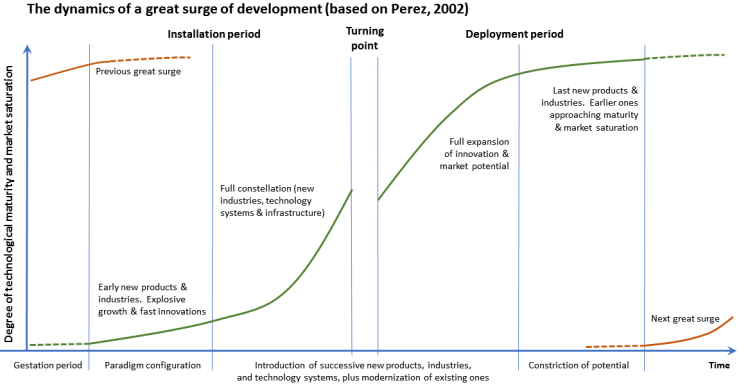
Economic surges, particularly those in the last 350 years, possess certain defining characteristics.  First, each surge coincides with the appearance of a new and greater source of energy and a set of innovations which take particular advantage of the new power source (or just of the availability of more energy) to create much new wealth.  The wave appears first in one leading economy, such as the U.K. or the U.S., and unfolds in stages.  (See diagram below).  The initial stage, called the installation period, begins during the previous surge as a new techno-economic paradigm forms.

Surge images v4 cropped

Each surge is powered by speculative financial capital, and a few people and industries accumulate very great wealth during the installation period of a surge.  As the change spreads, the labor force, and society as a whole, adapts–that is, they move into new jobs, though not docilely.  In each surge, there is typically a speculative bubble and a collapse, as well as significant internal and international strife, strikes, trade wars, and real war. For example, in the third wave we saw the rise of the robber barons—Andrew Carnegie in steel, J.B. Duke in tobacco, Jay Gould in railroads, Andrew Mellon in aluminum, J.P. Morgan in mergers, John D. Rockefeller in oil—and then the big anti-trust laws in 1890 and 1914.  The later part of this wave saw the formation of industrial unions and their final success after the 1920’s real estate bubble burst and the Great Depression set in.  World War I and II both had roots in the third wave, and the second war, with its huge government sponsored industrial expansion, launched the great post-war boom of the fourth wave.  But again, typically, as societal wealth grows more rapidly in the deployment phase, the political system negotiates a more equitable distribution of the economic gains, and tensions subside.

Leading sector timing and indicators, 15th to 21st centuries
Lead economy Leading sector Start-up phase

(installation)

High growth phase

(deployment)

Portugal Guinea gold 1430-460 1460-1494
Indian pepper 1494-1516 1516-1540
Netherlands Baltic, Atlantic trade 1540-1560 1560-1580
Eastern trade 1580-1609 1609-1640
Britain Amerasian trade (sugar) 1640-1660 1660-1688
Amerasian trade 1688-1713 1713-1740
Britain Cotton, iron 1740-1763 1763-1792
Railroads, steam 1792-1815 1815-1850
United States Steel, chemicals, electronics 1850-1873 1873-1914
Motor vehicles, aviation, electronics 1914-1945 1945-1973
United States Information industries 1973-2000 2000-20??
?? Artificial intelligence, biotech ?? ??

Are we ready for another surge?

Although the waves have similarities, they are obviously not identical, and the outcome of each wave is not pre-determined.  Nor is the leading economy guaranteed permanent success.  Portugal and the Netherlands had a turn before the British, and the U.S. succeeded the U.K.  Carlota Perez, one of the leading contemporary ‘wave’ theorists, argues that the next surge could be a “green” one, powered by renewable energy, closed loop resourcing, and the rise of several billion people into mass consumption lifestyles.  If her vision comes to pass, it has the added promise of heading off the catastrophe posed by climate change—which would likely destroy any surge that doesn’t address it.  For the sake of the current discussion, if not for our mental health, let’s assume that we will find a way to head off a climate catastrophe.   How are we doing in setting the stage for another rapid economic surge that will generate a rapid automation of existing work?

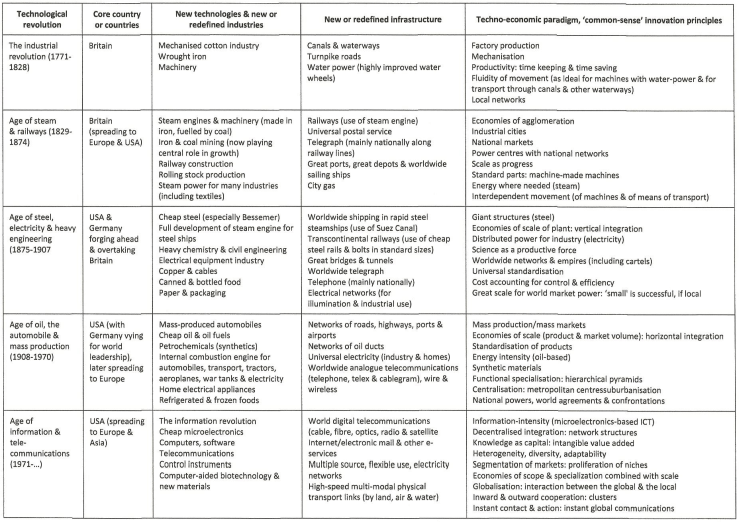
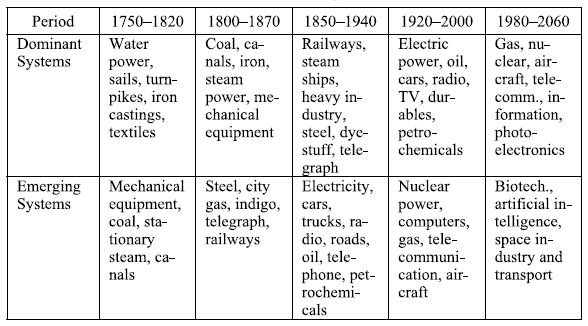
Five Great Surges of Development (according to Perez)

Schot-Sanger chart

Typically, according to Perez, each surge begins with a period driven by financial capital searching for new ways to make money when the technologies of the previous wave can no longer drive large profits.  This search by unfettered finance drives a bubble prosperity that inevitably collapses into a recession or worse.  This first phase, which Perez calls the “installation phase,” is characterized by growing income inequality.  (Remember the robber barons?  How about Larry Ellison, Bill Gates, Peter Thiel?)  Dissatisfaction with the inequality and the collapse allow governments to chart a course for the next surge of growth, which Perez calls the “deployment phase.” (20)

Perez describes the last complete two-phase growth surge:

In 1908, Ford’s model-T inaugurated the Age of the Automobile and Mass Production in the United States.  The great crash of 1929 ended the Roaring Twenties frenzy and led to the longest post-collapse recessive period to date: the 1930s.  Resistance to the New Deal may be seen as one of the root causes of the prolonged stagnation.  It took the experience of government-industry collaboration during World War II to enable acceptance of the full Welfare State and the Keynesian policies and institutions that facilitated the greatest economic boom in history.  (19, p.213)

The post-war boom petered out in the 1970s and a new installation period based on information, computers, and telecommunications began.  Bubbles based on the Internet and on complex, computerized financial instruments collapsed in 2001 and 2008.  Thus, we should be primed for another economic surge.  Are we?

What do we need, what do we have—what do we lack?

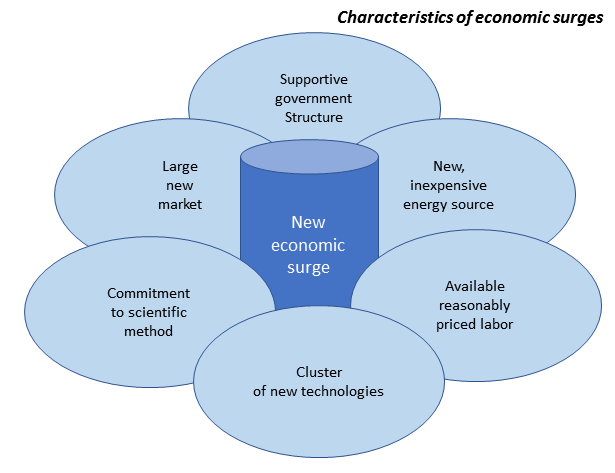
To answer this we can first note that previous economic surges shared several characteristics:

  • A cluster of new technologies that amplified each other and ultimately affected large segments of the economy—like automobiles and suburban housing growth after World War II.
  • A relatively inexpensive, new energy source—oil for the post-war boom.
  • A commitment to a scientific approach of applying technology along with a belief that improvements are both possible and desirable.
  • Available reasonably priced labor and a clear, large economic value—both resulting from the post-war baby boom.
  • A supportive government structure, like the Bretton Woods post-war conference that established the International Monetary Fund and the World Bank.
  • A large new market—like the auto-driven suburban build-out after World War II.

Characteristics of surges cropped v2

And we do have an unusually large and promising set of emerging technologies (as listed by the World Economic Forum) (21):

  • Self-driving vehicles.
  • Nano-sensors that can connect almost anything to anything else.
  • Perovskite solar cells that are lighter and cheaper than conventional solar cells.
  • New batteries that would make large-scale power storage possible.
  • Open artificial intelligence ecosystem.
  • Two-dimensional (super thin) materials.
  • Systems metabolic engineering, which gets chemicals from renewable micro-organisms.
  • Organs on a chip for medical testing.
  • Optogenetics, which uses light to control modified neurons.
  • The blockchain, which is a revolutionary decentralized trust system.

http://twoblokes.net/2017/07/25/objects-are-not-as-close-part-3


Objects are not as close as they appear—or are they?

One thing is clear about the future:  it’s murky. 

Technology will bring a new age of prosperity and wonder!  Technology will destroy our livelihoods and leave us slaves to robots!  Something earthshaking is coming! 

Or maybe this is a “tale Told by an idiot, full of sound and fury, Signifying nothing.”

Let’s take a look.

The current fear–our jobs

The greatest fear we have, right now, is that we are being made obsolete by our own machine creations.  That our work will be automated right out from under us. 

But if we can automate most work, how quickly will we do it?

Seems like a simple question.  But it’s not.

There is agreement that a great many work activities can be automated now.  Note that’s not jobs automated—it’s the work activities within all the jobs.   automation may break our jobs into machine digestible pieces, which is just a continuation of the chopping up of jobs that began in the 18th century with the introduction of water powered looms and culminated with the assembly line.   We will delve more into the historical perspective a bit later.

In 2015, McKinsey “showed that currently demonstrated technologies could automate 45 percent of the activities people are paid to perform and that about 60 percent of all occupations could see 30 percent or more of their constituent activities automated, again with technologies available today.” (1)  Globally, those work activities represent the equivalent of 1.1 billion workers and $15.8 trillion in wages. (2)  Or, as the World Bank reported in 2016, “two-thirds of all jobs are susceptible to automation in the developing world, but the effects are moderated by lower wages and slower technology adoption.” (3)

But you cannot just eliminate tasks within jobs without endangering the number of jobs.  While one potential future might have workers doing half as much for the same pay, most don’t.   A widely referenced study by Carl Benedikt Frey and Michael A. Osborne in 2013 using 2010 data estimated that “47 percent of total US employment is in the high risk category, meaning that associated occupations are potentially automatable over some unspecified number of years, perhaps a decade or two.” (4)  This study did look at whole jobs and assigned probabilities of computerization for each of nine dimensions (such as negotiation, caring for others, manual dexterity), so each of 700 jobs has its own overall probability.  High risk means that the job has a 70% or greater probability of automation within 10 years.

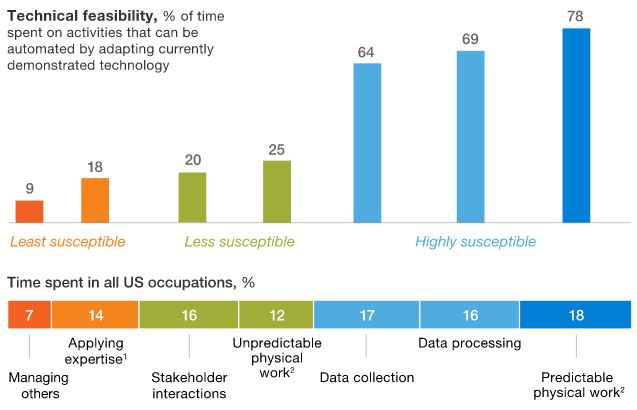
In 2016, McKinsey dug in again and produced this chart:

McKinsey tech feasibility

Tasks that occupy 51% of all work time in the U.S. today are highly susceptible to automation.  Those are not all low-wage jobs either.  Already machines using artificial intelligence are significantly better than experienced doctors at reading CT scans and X-rays. (5)  Of course, some workers at risk are low-wage, like the fast food employees that the CEO of CKE Restaurants Andy Puzder would like to replace with robots because “they’re always polite, they always upsell, they never take a vacation, they never show up late, there’s never a slip-and-fall, or an age, sex or race discrimination case.” (6)

Some economists argue that automation also creates new jobs as it destroys old ones.  Blacksmiths and stable keepers did not fare well as Fords began to roam the world, but auto mechanics, oil field workers and motel keepers did.  However, automation now focuses as much or more on thinking tasks as on mechanical tasks.  Jobs that Frey and Osborne rate as most likely to be automated (98 or 99% probability) include insurance underwriters, tax preparers, loan officers, insurance appraisers, credit analysts, claims adjusters, and bookkeepers.  The range of things that humans can do better than machines may shrink faster than new human tasks are created .

Is it a slam dunk?

Of course, factors other than technical feasibility enter into any decision to replace a person with a machine: the cost of the machine, the cost of labor, even interest rates and CEO prejudices come into play.  But one real catch to whether this change will occur quickly lies in the difficulty of successfully changing organizational processes—because that’s what it means to automate work activities and reorganize jobs.  Although we’ve been trying to do this since the dawn of machines, we’ve been at it most seriously since computers became common in the 1970s and 1980s.  Yet “most studies still show a 60-70% failure rate for organizational change projects–a statistic that has stayed constant from the 1970’s.” (7)  According to Gartner Group, automation-driven changes, like private cloud implementations, can have even higher failure rates—as high as 95%. (8)

The biggest cause of all these failures?  The most common problem by far is the interface between the people and the automation—that is, failing to change the work processes, failing to design automation to interact with people, and failing to sufficiently train the people who must use new processes and interact with new machines or software.  A 2011 Swedish survey of managers found that “seventy-five percent of managers of all ages admitted to using an open-source tool or spreadsheet—or simply refusing to use the system—if the interface is hard to use.”  If the managers won’t use it, will anyone else?  (9)

Two of the biggest automation introduction disasters cost the U.K. National Health System £10 billion and the U.S. Air Force $1 billion, but it’s easy to find automation project failures in every industry, including computers: HP reportedly lost $160 million on one project. (10)  Does this shed some light on why non-farm business labor productivity has increased an average of 1.9% per year since 1969, compared to 3.4% annual increases from 1948 through 1968, pre-computerization? (11)  Or maybe why GDP grew only 2.6% per year after 1979, compared to 3.9% from 1948 to 1979?  (12,13)   Still, we keep trying, and we’re not likely to stop.

But we both digress and jump ahead of our story.

Revolutions:  past and present

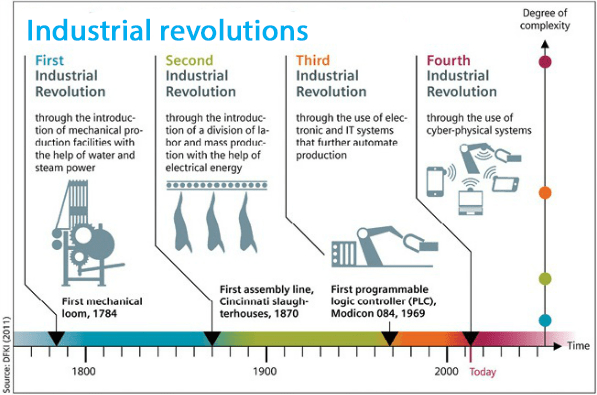
There is a broader perspective on job automation that we must examine and the clue to that perspective comes from the recent World Economic Forum at Davos.  One of this year’s topics was a Fourth Industrial Revolution based on artificial intelligence and biotechnology, among other emerging technologies.  (See list on page 9.)  For completeness sake, the first industrial revolution encompassed coal, iron and steam, the second one electricity and steel, and third included the automobile and oil.  All four revolutions brought colossal changes to the affected societies—remember the days before highways, suburbs and fast food?–but the fourth stands to be the most massive change yet: we may be able to transform the earth, make all people prosperous, and even create machines that are more intelligent than we are.  Just as railroads and electricity brought huge changes in human society in the 19th and 20th centuries, collapsing distances and making possible a vast array of new devices and capabilities (light bulbs, radios, TVs).  With nano-sensors, super thin materials and chemicals from renewable micro-organisms, combined with AI and biotechnology, we are poised for an even greater transformation in the 21st.  For example, nano-sensors might allow us to avoid serious disease or deterioration and greatly extend our active lifespan.  For example, could monitor plaque buildup in your arteries, or an engineered microbe might actually remove it.

4 IRs 2B

In fact, a group of economists, sometimes known as evolutionary economists, have done broad research into how technology and innovation have driven economic growth and social change in the past.  They include Chris Freeman in the U.K., Francisco Louçã in Portugal, Carlota Perez of Venezuela, and William R. Thompson of the U.S.  They trace their roots to the early political economists, such as Adam Smith and Karl Marx, and later to Joseph Schumpeter.  It was Schumpeter who coined the term “creative destruction,” that is in vogue among entrepreneurs, especially in Silicon Valley.  Creative destruction is the capitalist “process of industrial mutation that incessantly revolutionizes the economic structure from within, incessantly destroying the old one, incessantly creating a new one.” (14)  This is the classic capitalist process that destroys old jobs and creates new ones: the rise of web-based music providers like iTunes and Spotify and the decline of the great vinyl and CD music publishers is a good example.

Schumpeter focused mainly on innovation as the driver of change, but his evolutionary economist successors go further to argue that “the evolution of the global economy depends on the interaction and co-evolution of several subsystems of society…certainly including technology and science, but also politics, economics, and culture.” (15)  For example, mechanical looms replaced home-based weaving and eliminated a whole class of artisans by relying on unskilled labor.  Railroads required precise timekeeping across broad territories and prompted growth of the first large, distributed organizations, managed via electric communications (the telegraph).  Railroads and factories not only rigidified time by standardizing it across the whole planet, they also led to the previously unimagined concept that “time is money.”  Faster transport meant more goods could be sold in a given timespan, and large investments in machines could be paid for more quickly if the machines ran longer each day.

Regular patterns in history?

What is especially noteworthy, and intriguing, about these evolutionary economists is that, although they have different points of emphasis, they all see a regular recurring pattern in socio-economic history.  Specifically, they point to a common pattern in the periods of rapid economic growth since capitalism took off with the British Industrial Revolution.  First, there is always a cluster of technologies that together enable a significant jump in productivity, first in one part of the economy—the leading sector–but then broadly across the whole economy.  The first revolution, for example, started with textile factories powered by water and steam replacing skilled artisans working at home or in small shops.  Steam-powered looms using stored energy (coal) and run by unskilled labor (often children) vastly increased cloth production.  The example of this success sparked the use of steam power throughout the British economy, most notably in transport (railroads).

Then as the technologies are widely adopted, the type of work and the way the work is done undergoes significant changes.  The second industrial revolution brought oil, steel, chemicals, electricity, and Ford-style mass production.  In the heyday of manufacturing, one worker might specialize in assembling the casing of a motor, and a factory might specialize in producing starter motors for automobiles.  Workers were by then several steps removed from a finished product: they no longer had the satisfaction of creating a complete product.  Ford increased the pay of his workers not only so they afford a Model T but so they would keep working on the mind-numbing assembly line.  This effect, which Marx called “alienation,” is echoed today in the further splitting up of meaningful jobs into atomistic tasks suitable for automation.  The tasks remaining for humans can be as mind numbing as the those of the workers on Ford’s assembly line.

Finally, the scale of the change affects both institutions and politics, and the society undergoes considerable tumult as new industries seek to establish themselves alongside the old ones.  In the third revolution, for example, when computer automation moved into factories and offices manufacturing’s share of total employment fell from about 25% to barely 8%, with total manufacturing jobs peaking at 19.4 million in 1979 before falling to 11.5 million in 2010. (16)  .  (This happened despite manufacturing remaining about constant at roughly 12% of GDP every year from 1960 to 2011.)   Similarly, a host of clerical workers disappeared from insurance companies and banks as mainframes moved in during the 1970s and 80s.  Typing pools and even secretaries vanished across all industries as PCs appeared on office desks.  Whole cohorts of low-wage clerks were driven into health care or fast food emporiums.  But consider the wider changes.  PCs not only eliminated typists and stenographers, they also rearranged who did what and changes expectations for clerical and non-clerical workers.  Managers kept their own schedules, wrote their own memos and worked longer hours; it no longer took several days to change and re-distribute a document; the art of dictation, spelling, and perhaps forethought declined, and vice-presidents felt compelled to “improve” everything that crossed their paths.

http://twoblokes.net/2017/07/25/objects-are-not-as-close-part-2